 Skip-the-line available
 The History of the Uffizi Galleries
From Medici offices to one of the world's first public museums — Vasari's building, the Tribuna, the Medici bequest, and the making of the Uffizi.
The Uffizi began not as a gallery but as a set of offices. Giorgio Vasari designed the long twin-winged building from 1560 for Cosimo I de' Medici to consolidate Florence's administrative magistracies — the uffizi, or offices, that gave it its name — and it was completed in 1581. Over the following centuries the Medici filled its upper floors with art, the octagonal Tribuna was built to show their treasures, and Anna Maria Luisa de' Medici's family pact secured the collection for Florence. This guide traces that arc: the building, the collection, the Tribuna and Vasari Corridor, the Medici bequest, and the Uffizi's emergence as one of the first public museums in Europe.
Who built the Uffizi and when?
The Uffizi was designed by the painter, architect and biographer Giorgio Vasari, who began the building in 1560 for Cosimo I de' Medici, the first Grand Duke of Tuscany. Its purpose was administrative: Cosimo wanted the scattered magistracies and guilds of Florence gathered into a single building beside the Palazzo Vecchio, the seat of government, so the complex was literally the city offices — the uffizi. The design is a long U of two wings joined at the river end, framing a narrow courtyard that runs down to the Arno. Vasari died in 1574 before the work was finished, and it was completed in 1581 with contributions from Alfonso Parigi and Bernardo Buontalenti. The courtyard's disciplined, repeating facade is often described as one of the first regularised streetscapes in Europe. Vasari, better known today as the author of the Lives of the Artists, thus shaped not only how the Renaissance is remembered in words but also one of the buildings that most defines Florence in stone.
Vasari's building was a feat of engineering as much as design, threading a monumental structure through a dense medieval quarter and out to the very edge of the Arno on made ground. The upper storey was conceived from early on as a covered gallery — a place to walk and display — which is how the word gallery came to describe the long light-filled corridors that still define the visit. The riverfront end, with its great arch opening to the Arno, gave the Medici a private route toward the river and their other properties. Even before it held its greatest paintings, the Uffizi was a statement of Medici power and order, its symmetry and length announcing a ruling family that meant to be permanent in Florence. Placing the offices directly beside the Palazzo Vecchio and linking them physically to it also concentrated the machinery of the Tuscan state into one commanding riverside address under the family's eye.
How did the Uffizi become an art collection?
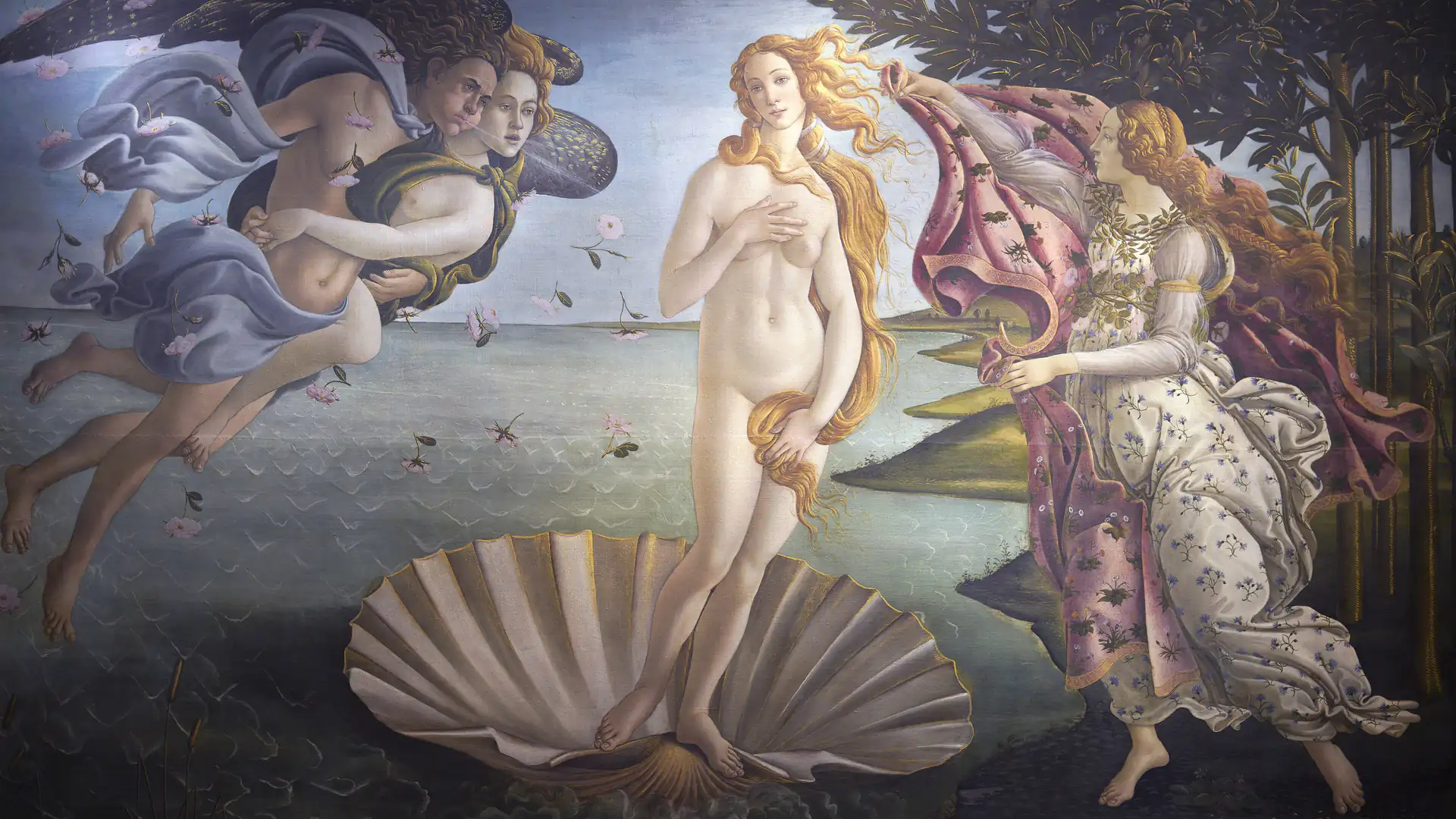
The Uffizi filled with art gradually as the Medici moved their treasures into the top floor of the offices. From the later sixteenth century the upper gallery displayed the family's growing hoard of ancient sculpture, paintings, gems and curiosities, arranged for private viewing and for impressing visiting dignitaries. Successive Medici added to it: portraits of the dynasty, works by the great Florentine and Venetian painters, and antiquities gathered from Rome. What had been a working office building became, room by room, a private museum in the modern sense — objects selected, arranged and shown for their beauty and learning rather than merely stored. The collection grew across generations into one of the most important assemblages of Italian Renaissance art anywhere, still on the floors Vasari had built. Because the Medici were patrons as well as collectors, many of the works were commissioned directly from the artists, giving the gallery an unusually direct line back to the studios of Botticelli, Leonardo and Michelangelo.
The heart of the Medici display was the Tribuna, an octagonal room completed in 1584 to the design of Bernardo Buontalenti as a jewel box for the family's most prized objects. Under a dome inlaid with mother-of-pearl, it gathered ancient statues, small bronzes, portraits and precious stones in a single dazzling space, and it became one of the most celebrated rooms in Europe, painted and described by generations of visitors on the Grand Tour. The Tribuna set a pattern for how a great collection could be staged, and it survives as one of the oldest purpose-built museum rooms in the world. To stand in its doorway today is to see the Renaissance idea of the museum almost exactly as the Medici conceived it. The room was designed to blend the four elements symbolically in its decoration, a reminder that for its makers a great collection was meant to model the whole of creation, not merely to display fine objects.
What was the Medici bequest and the family pact?
The survival of the Uffizi collection in Florence rests on a single remarkable decision. When the Medici male line died out, Anna Maria Luisa de' Medici, the last of the dynasty, signed a settlement — remembered as the Patto di famiglia, or family pact — that gave the vast Medici holdings of art to the state of Tuscany on the condition that nothing ever be removed from Florence. The pact bound the treasures to the city in perpetuity, ensuring that the paintings, sculptures and antiquities the family had gathered over two centuries could never be sold off, dispersed or carried away by a new ruling house. It is one of the earliest and most consequential acts of cultural heritage protection in European history, and the reason the Uffizi's masterpieces are still in Florence today.
That decision transformed a private dynastic collection into a public trust. The Uffizi was opened to visitors by request in the eighteenth century and was officially opened to the public in 1769, formally becoming a museum in 1865, which places it among the very first public art museums in the world. Where the Medici had shown their treasures to select guests, the gallery now welcomed a broadening public, and over time the administrative offices were given over entirely to art. The through-line from Cosimo I's offices to a museum open to all runs directly through Anna Maria Luisa's pact — the moment a family's private glory became a city's shared inheritance and, in time, a destination for millions. Anna Maria Luisa's foresight is still honoured in Florence each year on the anniversary of her death, a rare case of a museum's public celebrating the individual who ensured its treasures would never leave the city.
What is the Vasari Corridor?
The Vasari Corridor is an elevated, enclosed walkway that Giorgio Vasari built in 1565, on the orders of Cosimo I de' Medici, to link the Palazzo Vecchio and the seat of government with the Palazzo Pitti, the Medici residence across the Arno. Running for close to a kilometre, it threads through the upper level of the Uffizi, along the riverbank, and famously across the top of the Ponte Vecchio, letting the ruling family move between their palaces without descending into the streets or mixing with the crowds. It was built at extraordinary speed for a state occasion. As a piece of architecture it is a vivid expression of Renaissance princely power — a private road in the sky above a public bridge. That a passage nearly a kilometre long could be raised through a crowded city in a matter of months speaks to both the ambition of the Medici and the command Vasari held over Florence's builders.
The corridor's construction reshaped the Ponte Vecchio itself: to keep the route clean and free of unpleasant smells for the Medici, the butchers who had traded on the bridge were reportedly moved off and replaced by goldsmiths and jewellers, whose shops line it to this day. For centuries the corridor was hung with paintings, including a renowned collection of artists' self-portraits, glimpsed only by privileged visitors. It connects directly to the Uffizi's galleries, making the museum, the bridge and the Pitti a single linked ensemble of Medici Florence. When open to the public it offers a rare walk above the river and a perspective on the city no ordinary street affords — one of the most atmospheric spaces in the whole Uffizi complex. Its round windows over the Arno were later altered for a wartime visit, and the corridor has since been restored, so a walk through it layers four centuries of Florentine history into a single elevated passage above the river.
What has happened to the Uffizi in modern times?
The modern Uffizi is one of the most visited art museums in the world, drawing well over five million people a year to a building never designed for such numbers, which is why entry is now managed through reserved time slots and, since 2025, nominative tickets checked against ID. Across the twentieth and twenty-first centuries the galleries have been repeatedly rearranged and expanded — new rooms opened, the lighting and climate improved, and works redistributed to tell the story of the collection more clearly. The institution today is part of a wider group that also takes in the Palazzo Pitti and the Boboli Gardens, so a single visit sits within a much larger Medici landscape spread across both banks of the Arno. Rooms once given over to clerks and magistrates now hold Caravaggio and Titian, and the gradual conversion of the entire building to display space is still, in a sense, going on as new galleries open.
The Uffizi has also weathered disaster. On 27 May 1993 a car bomb, later attributed to organised crime, exploded beside the gallery in the early hours, killing five people, destroying several works and damaging many others along with part of the building. The gallery was repaired and reopened, and the attack became a landmark in Italy's defence of its cultural heritage. In the decades since, the Uffizi has embraced a broad public mission — conservation, research, loans and digital access to its holdings — while remaining rooted in Vasari's sixteenth-century walls. From Cosimo I's offices to a global museum, its long history is written into the building itself, room by room, along the corridors that first gave the world the word gallery. Few museums wear their history so openly: to walk the Uffizi is to move through five centuries of Florentine ambition, from a duke's offices to a bombed and rebuilt monument that now shares its Renaissance treasures with the world.
Frequently asked
Who built the Uffizi and when?
Giorgio Vasari designed it from 1560 for Cosimo I de' Medici, first Grand Duke of Tuscany. Vasari died in 1574, and the building was completed in 1581 with contributions from Alfonso Parigi and Bernardo Buontalenti.
Why is it called the Uffizi?
Uffizi means offices in Italian. Cosimo I de' Medici commissioned the building to gather Florence's scattered administrative magistracies and guilds into a single complex beside the Palazzo Vecchio, so it was literally the city offices.
When did the Uffizi become a public museum?
The Uffizi was officially opened to the public in 1769 and formally became a museum in 1865, placing it among the earliest public art museums in the world, though the Medici had shown the collection to select guests long before.
What was the Medici family pact?
The Patto di famiglia was a settlement signed by Anna Maria Luisa de' Medici, the last of the line, giving the Medici art to Tuscany on condition that nothing ever leave Florence. It kept the collection in the city permanently.
What is the Tribuna at the Uffizi?
The Tribuna is an octagonal room completed in 1584 to Bernardo Buontalenti's design, built as a jewel box for the Medici's finest treasures under a mother-of-pearl dome. It is one of the oldest purpose-built museum rooms in the world.
What is the Vasari Corridor?
An elevated enclosed walkway built by Vasari in 1565 to link the Palazzo Vecchio through the Uffizi and over the Ponte Vecchio to the Palazzo Pitti, letting the Medici cross the city unseen. It runs close to a kilometre above the streets.
Why are there jewellers on the Ponte Vecchio?
When the Vasari Corridor was built over the bridge in 1565, the butchers who traded there were reportedly moved off and replaced by goldsmiths and jewellers so the Medici's private route would stay clean. Their shops line the bridge to this day.
Was the Uffizi ever damaged?
Yes. On 27 May 1993 a car bomb exploded beside the gallery, killing five people and destroying or damaging a number of artworks and part of the building. The Uffizi was repaired and reopened, and the attack marked a turning point in protecting Italy's heritage.