 Skip-the-line available
 What to See in the Uffizi Galleries
The must-see masterpieces room by room — Botticelli's Birth of Venus, Leonardo, Michelangelo, Raphael, Titian and Caravaggio — and the smartest order to see them.
The Uffizi holds one of the world's greatest collections of Italian Renaissance art across roughly ninety upper-floor rooms, and the highlights are concentrated enough to see in a focused half-day. The essential works are Botticelli's Birth of Venus and Primavera, Leonardo da Vinci's Annunciation and Adoration of the Magi, Michelangelo's Doni Tondo, Raphael, Titian's Venus of Urbino, and Caravaggio's Medusa and Bacchus, with Giotto and Piero della Francesca anchoring the early galleries. This guide walks the collection room by room, names the single works you should not miss, and gives the concierge order for seeing the most famous paintings while the rooms are still quiet.
What are the most famous paintings in the Uffizi?
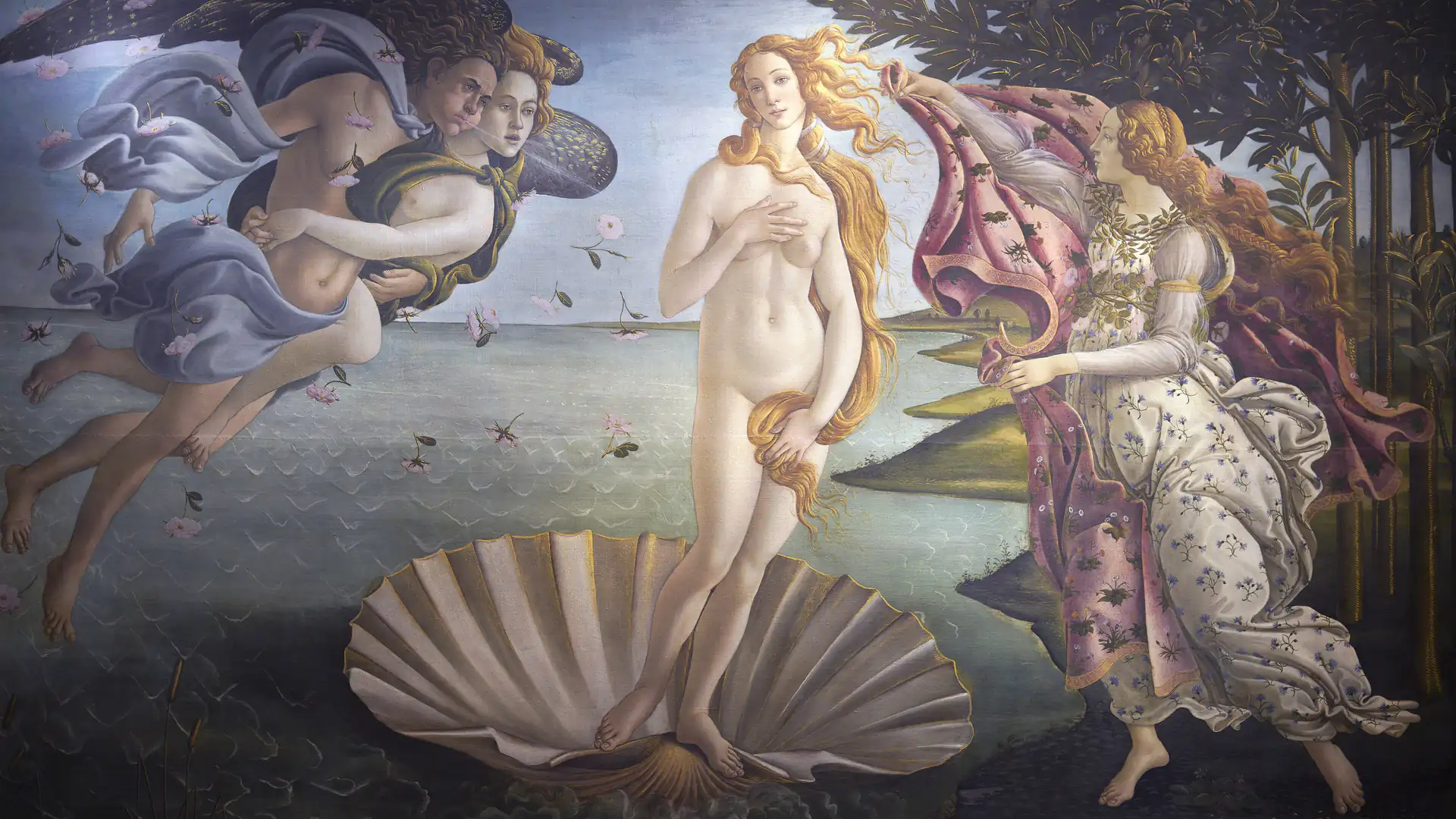
The most famous paintings in the Uffizi are Sandro Botticelli's Birth of Venus and Primavera, displayed together in the Botticelli rooms and among the defining images of the Italian Renaissance. Close behind are Leonardo da Vinci's early Annunciation and his unfinished Adoration of the Magi; Michelangelo's Doni Tondo, his only surviving finished panel painting, blazing in its original frame; and Titian's Venus of Urbino, a landmark of Venetian painting. Raphael is represented by portraits and Madonnas, and the Caravaggio room holds his shield-painted Medusa and his youthful Bacchus. Together these works trace the arc of Italian art from the fourteenth to the seventeenth century under one roof. If you see only a handful of rooms, make them the Botticelli gallery, the Leonardo room, the Tribuna, and the Michelangelo and Caravaggio rooms. Between them these few spaces hold works by the artists most people picture when they think of the Renaissance, so even a short visit built around them feels complete rather than rushed.
Beyond the headline names, the Uffizi rewards a slower look at the works that shaped everything after them. Giotto's monumental Ognissanti Madonna opens the collection and marks the moment painting began to turn toward naturalism. Piero della Francesca's paired portraits of the Duke and Duchess of Urbino are among the most reproduced profiles in Western art. Paolo Uccello's Battle of San Romano experiments with early perspective, and the German and Flemish rooms hold works by Dürer and others that show how ideas crossed the Alps. The collection is arranged broadly by period and school, so walking the rooms in sequence tells the story of the Renaissance in order. Even a visitor with two hours can take in the giants and still catch these quieter turning points along the way. Reading the rooms in order is like watching painting learn to see: from Giotto's solid, weighty figures through the perspective experiments of the 1400s to the full confidence of the High Renaissance a few rooms later.
Which rooms hold Botticelli, Leonardo and Michelangelo?
The Botticelli rooms are the beating heart of the Uffizi and the reason many visitors come to Florence at all. Here the Birth of Venus, with Venus rising from a shell on the shore, hangs near the Primavera, an allegory of spring crowded with mythological figures in an orange grove — two of the most recognisable paintings in the world, shown together. In the adjoining spaces you will find more Botticelli alongside works by his contemporaries. The Leonardo room nearby holds his luminous Annunciation and the unfinished, deeply worked underpainting of the Adoration of the Magi, which shows a great artist thinking on the panel. These rooms sit on the same upper floor and are best seen first thing, before the mid-morning crowd fills the space in front of the Venus. Standing close, you can see the delicacy of Botticelli's line and the gold still glinting in the hair and the orange trees, detail lost when a crowd keeps you several metres back.
Michelangelo's Doni Tondo is the pivot of the collection for many visitors: a circular Holy Family in brilliant, almost sculptural colour, set in a carved frame the artist himself is thought to have designed, and his only surviving finished movable painting. It repays close attention to the twisting figures that anticipate the Sistine Ceiling. The octagonal Tribuna, one of the oldest museum rooms in Europe and completed in 1584, is a jewel box of Medici treasures — ancient sculpture, small bronzes and portraits under a mother-of-pearl dome — usually viewed from its doorways rather than entered. Plan your route to reach the Botticelli, Leonardo, Tribuna and Michelangelo rooms early, then work outward, because these are the spaces that draw the densest crowds as the day warms up. The Doni Tondo and the Tribuna sit close enough to the Leonardo and Botticelli rooms that a focused visitor can take in all four of the Uffizi's greatest names within the first half hour of a well-timed morning slot.
Where are Raphael, Titian and Caravaggio in the Uffizi?
The High Renaissance and beyond fill the rooms past the early masterpieces. Raphael is represented by refined portraits and tender Madonnas that show why he was the age's most admired painter, hung among his Florentine and Roman contemporaries. Titian's Venus of Urbino — a reclining nude that became one of the most influential images in European art and echoed for centuries afterward — is a highlight of the Venetian rooms, alongside other works that show Venice's love of colour and light against the Florentine emphasis on line. These galleries reward comparison: step between a Florentine panel and a Venetian canvas and the two great traditions of Italian painting come into focus side by side within a few metres. Raphael's Florentine years, when he absorbed lessons from both Leonardo and Michelangelo, are on show here too, so the rooms double as a lesson in how ideas travelled between the age's greatest rivals.
The Caravaggio room is a dramatic late note in the visit. Here hangs the Medusa, painted on a ceremonial wooden shield with the snake-haired head caught in mid-scream, and the sensuous Bacchus, a youthful god offering a glass of wine with startling realism. Caravaggio's harsh light and unidealised figures mark the shift from Renaissance to Baroque, and the room is a favourite for its theatrical intensity. These later rooms sit toward the end of the standard route, so they are often quieter in the morning when crowds cluster at the Botticelli end. A concierge tip: if the Botticelli rooms are packed when you arrive, walk the route in reverse and enjoy Caravaggio, Titian and Raphael in relative calm first, returning to Venus as the earliest groups move on. The Caravaggio room is compact, so it clears and fills quickly; catching it in a lull rewards you with an unhurried look at the Medusa's frozen scream and the sidelong glance of the young Bacchus.
What else is worth seeing at the Uffizi?
The Uffizi is more than its paintings. The building itself is a masterpiece: designed by Giorgio Vasari from 1560 for Cosimo I de' Medici and completed in 1581, it was built to house Florence's administrative offices — the uffizi, or offices, that give it its name. The third-floor corridors are lined with ancient Roman sculpture and hung with a famous run of portraits, and the loggia at the end offers one of the best framed views in Florence, straight along the courtyard to the Palazzo Vecchio tower and out over the Arno. Pausing at the windows between rooms is part of the experience, not a detour. Allow a little time simply to stand in the long galleries and take in the architecture that has shaped how museums are laid out ever since. The east and west corridors, with their painted grotesque ceilings and ranks of ancient busts, are among the most photographed interiors in the building even though not a single painting hangs in them.
One remarkable feature usually seen on a separate visit is the Vasari Corridor, the elevated passage Vasari built in 1565 to let the Medici walk unseen from the Palazzo Vecchio, through the Uffizi and across the top of the Ponte Vecchio to the Palazzo Pitti on the far bank of the Arno. It is a striking piece of Renaissance power architecture and, when open, offers a view over the river few visitors ever get. Elsewhere, watch for Gentile da Fabriano's gold-ground Adoration of the Magi, the room of Flemish and German painting with works by Dürer, and the sequence of self-portraits. The collection is deep enough that every return visit surfaces something new beyond the famous names. Many visitors also miss the ground-floor and mezzanine spaces used for temporary exhibitions and prints, so it is worth glancing at what is on during your visit before you climb to the main painting floors above.
In what order should I see the Uffizi masterpieces?
The concierge order for the Uffizi is to reach the crowd magnets first and let the rest of the collection unfold around them. Book an early slot, climb straight to the upper floor, and go directly to the Botticelli rooms while the space in front of the Birth of Venus is still open enough to stand back and take it in. From there, move to the Leonardo room for the Annunciation and the Adoration of the Magi, then the Tribuna and Michelangelo's Doni Tondo. Only after the headline works should you slow down and walk the earlier galleries — Giotto, Piero della Francesca, Uccello — in sequence. This puts your best light and lowest crowds on the most photographed paintings and leaves the quieter rooms for when energy flags. Marking your three or four must-see works on the gallery's room plan in advance turns a ninety-room building into a clear, walkable route.
If you arrive to find the Botticelli rooms already crowded, reverse the plan: walk the route backwards to enjoy Caravaggio, Titian and Raphael first, then arrive at the Botticelli gallery as the earliest tour groups drift away. Either way, budget two and a half to three and a half hours for a highlights visit and pace yourself — the Uffizi is a long building across two upper floors, and gallery fatigue is real. Build in a pause at the third-floor loggia for the view over the courtyard and the Arno, and keep a mental list of your three or four must-see works so a busy day never crowds them out. The collection is vast, but a clear order turns it into one of the great half-days in European art. Finish rather than fade: stop at the museum cafe terrace above the Loggia dei Lanzi for a rooftop view over Piazza della Signoria before you leave.
Frequently asked
What are the must-see works in the Uffizi?
Botticelli's Birth of Venus and Primavera, Leonardo da Vinci's Annunciation and Adoration of the Magi, Michelangelo's Doni Tondo, Titian's Venus of Urbino, Raphael's portraits and Madonnas, and Caravaggio's Medusa and Bacchus are the essential highlights.
Where is the Birth of Venus in the Uffizi?
Botticelli's Birth of Venus hangs in the Botticelli rooms on the Uffizi's upper floor, displayed alongside his Primavera. These rooms draw the densest crowds, so they are best seen in the first slot of the morning.
What did Leonardo da Vinci paint that is in the Uffizi?
The Uffizi holds Leonardo's early Annunciation and his unfinished Adoration of the Magi, whose worked-up underdrawing shows the artist composing on the panel. Both hang in the Leonardo room near the Botticelli gallery.
Is the original David in the Uffizi?
No. Michelangelo's original David has been in the Galleria dell'Accademia since 1873, about fifteen minutes' walk away. The Uffizi holds Michelangelo's painted Doni Tondo, his only surviving finished panel painting.
What is the Tribuna at the Uffizi?
The Tribuna is an octagonal room completed in 1584, one of the oldest museum spaces in Europe, built to display Medici treasures — ancient sculpture, bronzes and portraits under a mother-of-pearl dome. It is usually viewed from its doorways.
How long do I need to see the Uffizi?
Allow two and a half to three and a half hours for the highlights across the upper floors, or half a day to walk every room. The collection spans roughly ninety rooms, so most visitors focus on the famous works first.
What is the Vasari Corridor?
The Vasari Corridor is an elevated passage built by Giorgio Vasari in 1565 linking the Palazzo Vecchio through the Uffizi and over the Ponte Vecchio to the Palazzo Pitti, letting the Medici cross the city unseen. It is visited separately when open.
In what order should I see the Uffizi?
Go to the Botticelli rooms first while they are quiet, then Leonardo, the Tribuna and Michelangelo's Doni Tondo, then walk the earlier galleries and finish with Titian, Raphael and Caravaggio. Reverse the order if Botticelli is already crowded.
Who built the Uffizi and why?
Giorgio Vasari designed it from 1560 for Cosimo I de' Medici, and it was completed in 1581. It was built to house Florence's administrative offices — the uffizi, meaning offices, which gives the building its name.